


Direct-seeded Rice variety SAVA-134 FullPage® reduces methane emissions by nearly 90%,
improves water productivity and enhances carbon credit potential
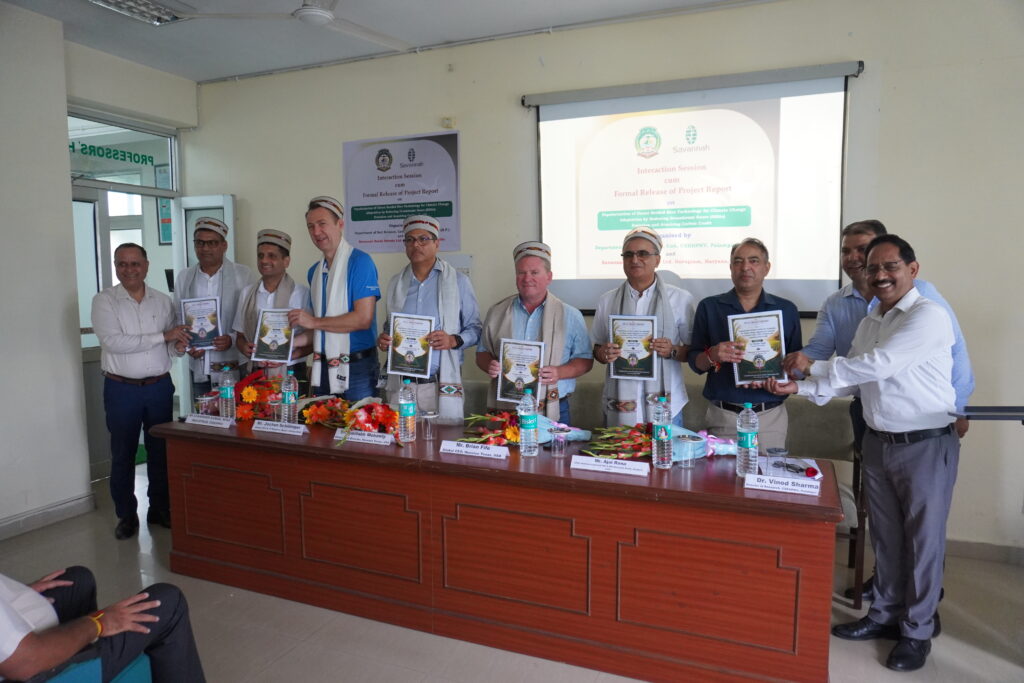
Mr. Brian Fife, Global CEO, Savannah Seeds, Houston, Texas, USA. Dr. Amitabh Mohanty, Global R&D Director,
Savannah Seeds, Houston, Texas, USA; Mr. Jochen Schillinger, Global CFO & IT Director, Savannah Seeds, Basel,
Switzerland; Mr. Ajai Rana, APAC Business Lead and CEO & MD, Savannah Seeds, Gurugram, India; visited the
Campus
Palampur, September 14, 2026: Chaudhary Sarwan Kumar Himachal Pradesh Krishi
Vishvavidyalaya Palampur, through its Department of Soil Science, College of Agriculture,
organized an interactive session to share the outcomes of its research project on “Popularization
of Direct-Seeded Rice Technology for Climate Change Adaptation by Reducing GHG Emissions
and Acquiring Carbon Credit.” Supported by Savannah Seeds, the project was conducted in two
major rice-growing regions of Himachal Pradesh with the objective of promoting climate-smart
and resource-efficient rice production.
The session was chaired by Mr. Brian Fife, Global CEO, Savannah Seeds, Houston,
Texas, USA. Other distinguished guests included Dr. Amitabh Mohanty, Global R&D Director,
Savannah Seeds, Houston, Texas, USA; Mr. Jochen Schillinger, Global CFO & IT Director,
Savannah Seeds, Basel, Switzerland; Mr. Ajai Rana, APAC Business Lead and CEO & MD,
Savannah Seeds, Gurugram, India; Dr. (Maj. Retd.) Avaninder Kumar, Registrar, CSKHPKV,
Palampur; and Dr. Vinod Sharma, Director of Research, CSKHPKV, Palampur.
The programme commenced with a welcome address by Dr. Anil Kumar, Head,
Department of Soil Science, CSKHPKV, Palampur, who welcomed the visiting delegates,
distinguished guests, faculty members, research staff and postgraduate students and highlighted
the importance of collaborative research in developing sustainable agricultural technologies.
Dr. Dhanbir Singh, Assistant Soil Chemist and Principal Investigator of the project,
presented the major outcomes of the multi-year study. He highlighted the performance of direct-
seeded SAVA-134 FullPage® in comparison with conventional transplanted rice systems. The
assessment focused on yield, water use, GHG emissions and soil health, with the findings
demonstrating the potential of the technology for climate-smart rice production. According to the
project findings, SAVA-134 FullPage® delivered the strongest overall performance among the
direct-seeded treatments evaluated. The technology reduced methane emissions by nearly 90 per
cent compared with conventional transplanted rice systems and recorded the highest water
productivity. It also showed the greatest potential for carbon credit generation. The study further
indicated improvements in important soil health parameters, including soil organic carbon,
microbial activity and water-holding capacity, along with reduced soil compaction. The
FullPage® system maintained strong yields while using fewer resources and generating a smaller
carbon footprint, highlighting its potential as a climate-smart approach to rice cultivation.
The distinguished guests Mr. Brian Fife, Dr. Amitabh Mohanty, Mr. Jochen Schillinger,
Mr. Ajai Rana, Dr. (Maj. Retd.) Avaninder Kumar and Dr. Vinod Sharma addressed the gathering
and shared their perspectives on sustainable agriculture, climate change adaptation, resource-use
efficiency and innovative technologies for rice production. Dr. N. K. Sankhyan, Registrar,
Central University of Himachal Pradesh and Dr. A. D. Bindra, Dean, College of Agriculture,
CSKHPKV, Palampur, also attended the programme. Research staff of the Department of Soil
Science and postgraduate students were present during the interactive session.
The session provided an important platform for researchers, academic experts, industry
representatives and students to exchange views on the potential of direct-seeded rice technology
for reducing GHG emissions, conserving water, improving soil health and creating opportunities
for carbon credit generation, thereby contributing to sustainable and climate-smart rice
production in Himachal Pradesh.