


shimla 21 september
Why did the government give up its water rights to save an annual investment of Rs 135.69 crore, asks BJP state president
Centre’s contribution pivotal to Rs 15,624-crore project; Chief Minister misrepresenting facts and claiming credit: Bindal
Rs 1,764-crore investment could be recovered in about two years if CM’s revenue projections hold true, says Bindal
BJP demands white paper on water rights, irrigation, local employment and financial implications of the agreement
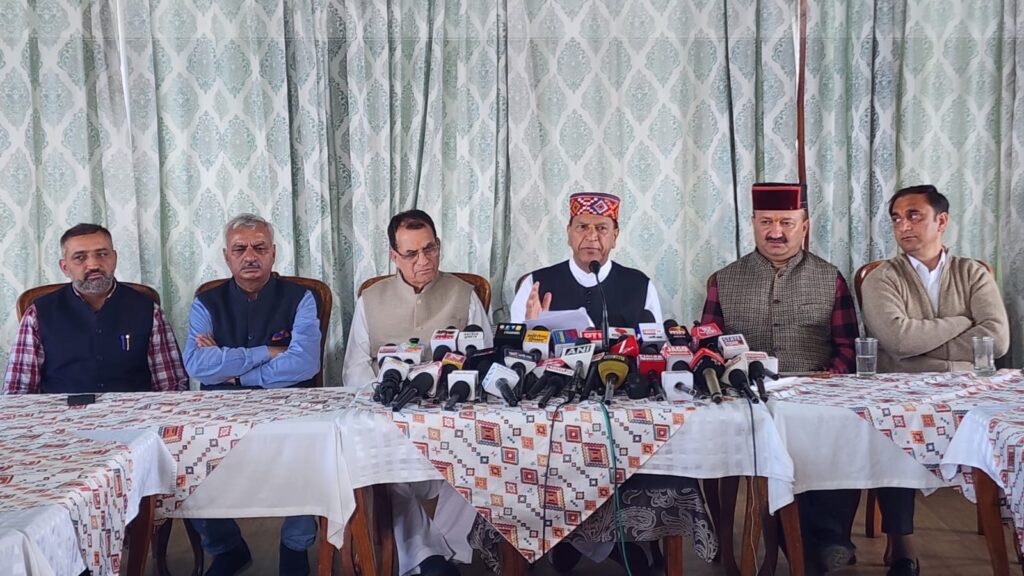
Shimla, September 21: Himachal Pradesh BJP president Dr Rajeev Bindal on Monday accused the Congress government of compromising the state’s long-term interests in the Kishau Dam project and questioned Chief Minister Sukhvinder Singh Sukhu over the financial terms of the recently concluded agreement.
Addressing a press conference, Bindal alleged that the Chief Minister was attempting to claim credit for a project that had moved forward primarily because of the intervention and financial support of the Union government led by Prime Minister Narendra Modi.
He said the BJP welcomed the agreement among the six participating states but demanded that the state government disclose its complete financial implications, particularly those concerning Himachal Pradesh’s water rights, irrigation potential and future revenue.
Bindal said the Chief Minister was presenting the agreement as a major achievement of his government without adequately explaining the Centre’s contribution or the concessions allegedly made by Himachal Pradesh.
Centre’s financial contribution crucial to project
Giving a detailed account of the project’s finances, Bindal said the estimated cost of the Kishau Dam project stood at Rs 15,624 crore, comprising a water component of Rs 12,096 crore and a power component of Rs 3,528 crore.
He claimed that the Union government’s decision to bear the cost of the water component had removed the principal financial obstacle that had prevented the project from progressing for decades.
Tracing the project’s history, Bindal said its conception dated back to the British era, with preliminary surveys undertaken in 1944-45. A detailed survey was subsequently conducted in 1962, followed by the preparation of a preliminary report in 1964.
Despite these developments, the project remained stalled for several decades because of unresolved financial and interstate issues, he said.
Bindal pointed out that discussions held in 2015 had failed to produce an agreement because the participating states were unwilling to shoulder the substantial cost of the water component.
He attributed the breakthrough to the Union government’s decision in principle in 2025 to assume the financial responsibility for the water component, which, according to him, paved the way for the agreement signed on September 15, 2026.
He also claimed that the Centre would bear the rehabilitation costs associated with displaced families, thereby reducing the financial burden on the participating states.
“The BJP wholeheartedly welcomes the Kishau Dam agreement. However, the credit for resolving the longstanding financial impasse must be acknowledged appropriately,” Bindal said, expressing gratitude to Prime Minister Narendra Modi and Union Home Minister Amit Shah.
Why abandon investment of Rs 1,764 crore, asks Bindal
Questioning the state government’s financial decisions, Bindal said Himachal Pradesh and Uttarakhand had agreed in 2015 to share the cost of the power component equally.
With the power component estimated at Rs 3,528 crore, Himachal Pradesh’s share would have amounted to Rs 1,764 crore.
He said that, assuming the expenditure was spread over 13 years until the project’s anticipated completion in 2040, the state’s average annual investment would have been approximately Rs 135.69 crore.
Bindal questioned whether the government had adequately examined the benefits of retaining its investment and associated rights in the project.
“Was an annual investment of Rs 135.69 crore such an overwhelming burden that the government had to compromise the state’s potential long-term benefits?” he asked.
He alleged that the government had prioritised immediate financial relief without presenting a comprehensive assessment of the revenue and other benefits that Himachal Pradesh might have secured through direct investment.
The BJP leader demanded that the government disclose whether an independent financial comparison had been conducted between the earlier investment arrangement and the revised agreement.
Government must explain changes to Himachal’s water rights
Bindal raised concerns about the implications of the agreement for Himachal Pradesh’s share of water from the Tons river.
Referring to the earlier water-sharing arrangement, he said Haryana had been allocated 40.6 per cent, Uttar Pradesh 30.1 per cent, Delhi 10.4 per cent and Rajasthan 6.3 per cent, while Himachal Pradesh and Uttarakhand had been assigned 1.7 per cent each.
He claimed that Himachal Pradesh’s entitlement amounted to approximately 50 million cubic metres of water and alleged that the revised agreement had altered the state’s rights over this resource.
According to Bindal, Delhi and Rajasthan had agreed to contribute approximately Rs 1,323 crore and Rs 441 crore, respectively, under the revised financial arrangement.
He questioned whether the state government had assessed the long-term economic value of the water involved, particularly in view of future irrigation, drinking water and agricultural requirements.
“Water is not merely a financial commodity. It is a resource on which the livelihoods of future generations will depend. The government must explain whether Himachal Pradesh has surrendered any permanent rights and, if so, under what conditions,” he said.
Bindal demanded that the government clarify whether the changes in water entitlements were permanent or subject to a specified period.
He also sought details of the provisions available to Himachal Pradesh should its domestic, agricultural or industrial water requirements increase in the future.
CM’s Rs 1,200-crore annual revenue claim raises questions
Referring to the Chief Minister’s statements about the financial benefits of the project, Bindal said Sukhu had projected an annual revenue of approximately Rs 1,200 crore for Himachal Pradesh.
He argued that if this projection were used as the basis for evaluating the project, the state’s proposed investment of Rs 1,764 crore would be equivalent to approximately one-and-a-half years of projected revenue.
He said the government should explain why it had decided against direct investment if the project offered such substantial financial returns.
“Even after accounting for interest and other financial liabilities, the government should establish how long it would have taken to recover the investment. Why was this option not properly evaluated?” Bindal asked.
The BJP president stressed that the Chief Minister should disclose the assumptions underlying the Rs 1,200-crore revenue projection.
These should include the electricity generation estimates, the state’s entitlement, expected sale price, operating expenditure and actual net revenue.
He also called for an assessment of future electricity market conditions, particularly the potential impact of increasing solar power capacity on electricity tariffs.
Bindal said the financial viability of a hydropower project could not be determined solely on the basis of projected gross revenue without considering capital expenditure, borrowing costs and operating expenses.
Sirmaur farmers could lose future irrigation opportunities
Raising the issue of agricultural development, Bindal alleged that the state government had failed to adequately safeguard the future irrigation requirements of farmers in Sirmaur district.
He said the Kishau Dam project should be viewed not merely as a power-generation initiative but also as a potential source of irrigation, agricultural expansion and rural economic development.
The construction of a major dam on the Tons river could create opportunities for expanding irrigation infrastructure in surrounding areas, he said.
Citing the example of the Giribata project, Bindal said the development of irrigation facilities alongside power generation had contributed to agricultural growth in the Paonta Doon region.
He said irrigation infrastructure had helped farmers diversify agricultural activities and improve productivity.
According to Bindal, the Kishau project could similarly create opportunities for agriculture and horticulture in parts of Sirmaur, provided adequate water rights and irrigation infrastructure were secured.
He alleged that the government had failed to adequately explain how these opportunities would be protected under the revised agreement.
“Uttarakhand is retaining the opportunity to develop irrigation infrastructure using its water entitlement. The Himachal government must explain what comparable arrangements have been secured for the farmers of Sirmaur,” he said.
Bindal demanded a detailed assessment of the potential irrigation area, proposed canal networks, agricultural productivity and expected impact on farmers’ incomes.
Local employment and business opportunities must be protected
The BJP president also questioned the government’s arrangements for ensuring employment and economic opportunities for local residents.
He said a project of this magnitude could generate employment during construction and subsequent operations, besides creating business opportunities in transportation, machinery, construction materials, hospitality and allied services.
Bindal asked whether the agreement contained binding provisions for employing Himachali youth and providing opportunities to local contractors and entrepreneurs.
He demanded that the government disclose the estimated number of direct and indirect jobs expected to be generated and the proposed share of local residents in those opportunities.
The government should also explain whether any specific provisions had been made for skill development, technical training and rehabilitation-linked employment for affected families, he added.
Bindal alleged that the Congress government was concentrating on publicity while failing to adequately address questions concerning employment, farmers’ rights and the long-term interests of affected communities.
BJP demands white paper on Kishau agreement
Calling for greater transparency, Bindal demanded that the state government release the complete agreement and publish a comprehensive white paper on the Kishau Dam project.
He said the document should clearly specify the financial contributions of the Centre and participating states, Himachal Pradesh’s water and electricity entitlements, projected revenue, investment obligations and the provisions relating to irrigation, rehabilitation and local employment.
The BJP leader also questioned the government’s publicity expenditure following the signing of the agreement and said the people of Himachal Pradesh deserved detailed information about the project’s actual benefits rather than promotional claims.
Reiterating his party’s support for the project, Bindal said the BJP welcomed the resolution of a longstanding interstate issue and acknowledged the Union government’s role in facilitating the agreement.
He maintained, however, that the state government’s decisions concerning Himachal Pradesh’s long-term economic and water interests required public scrutiny.
“The Chief Minister must tell the people exactly what Himachal Pradesh has gained, which rights have been modified and what safeguards have been secured for future generations. The state’s water, electricity, agriculture and employment interests cannot be left to unanswered questions,” Bindal said.
Editorial verification note: This release attributes the political allegations and financial claims to Dr Bindal. The final agreement should be checked to establish the precise Central funding commitment, any transfer of water rights and the Delhi–Rajasthan contributions. The suggested investment recovery period compares capital expenditure with projected gross revenue and does not establish net profitability.