


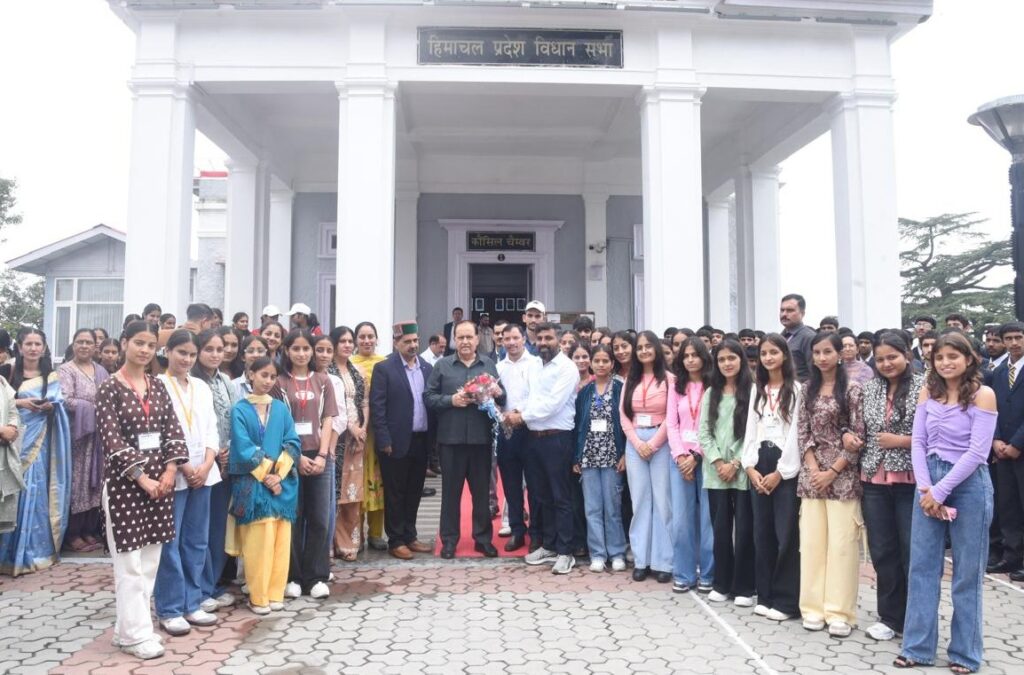
Shimla: Around 210 students from Government College Chuwari, Chamba district; Government Senior Secondary School Spatu, Solan district; Government Senior Secondary School Tutikandi, St. Bede’s College, Sanjauli; and Government Senior Secondary School Baldian, Shimla district, visited the Himachal Pradesh Legislative Assembly Secretariat at 10:30 AM today and interacted with Himachal Pradesh Legislative Assembly Speaker Kuldeep Singh Pathania outside the Council Chamber.
During the interaction, the Speaker apprised the students in detail about the parliamentary system, the democratic framework of the country, and the functioning of the Legislative Assembly, Lok Sabha and Rajya Sabha. He informed the students that Legislative Councils are also provided for in some larger states. However, Himachal Pradesh, being a small state, does not have a Legislative Council.
Pathania said that the Lok Sabha and State Legislative Assemblies are among the most important institutions of democracy. He explained that elected Members of Parliament constitute the Lok Sabha, and the political party securing a majority forms the government at the Centre. The majority party elects its leader, who becomes the Prime Minister, following which the Council of Ministers is constituted.
He further explained that members of the Rajya Sabha are elected indirectly by the elected members of State Legislative Assemblies. At present, the Lok Sabha has 543 members, while the Rajya Sabha has 245 members, including 233 representatives of the States and Union Territories and 12 nominated members appointed by the President of India. The Lok Sabha has a tenure of five years, while members of the Rajya Sabha have a six-year term. The Rajya Sabha is known as the Upper House and the Lok Sabha as the Lower House.
Interacting with the students of St. Bede’s College, Pathania said that the historic building in which they were standing is known as the Council Chamber. The construction of the building began in 1920 and was completed in 1925. It took five years to complete and cost around Rs. 10 lakh at the time. The building was constructed by the then British Government as the Council Chamber, primarily as a dedicated building for the National Assembly.
Pathania said that although Frederick Whyte was the first nominated Speaker of the National Assembly, Vithalbhai Patel became its first elected Indian Speaker in 1925 after defeating his British rival by two votes in this very chamber. He said the historic building has witnessed several important events. The right of women to vote and the Quit India resolution were also passed in this chamber.
He further informed the students that the chair on which the Speaker sits inside the House was gifted by the Burmese Government to the then British Government in 1925.
The Speaker invited all the students to witness the proceedings of the Legislative Assembly and extended his best wishes for their bright future.